North & South 24 Parganas – Where the Ganges Meets the Sea Wild, Wonderful, Waterlogged – The Twin Parganas of Bengal. A world where rivers breathe and forests roar, where the Bengal tiger still rules supreme and fishing boats dot […]
Wild, Wonderful, Waterlogged – The Twin Parganas of Bengal.
A world where rivers breathe and forests roar, where the Bengal tiger still rules supreme and fishing boats dot a thousand waterways. North and South 24 Parganas are two sides of the same extraordinary coin – twin districts that cradle India’s most cosmopolitan city on one side and the planet’s mightiest mangrove wilderness on the other. Here, colonial bungalows stand beside ancient temples, hilsa fish sizzles in mustard oil in riverside villages, and the world’s largest delta whispers stories of kingdoms, colonisers, and creatures found nowhere else on Earth. This is Bengal at its most raw, most real, and most riveting.
District HQ (North 24 Parganas): Barasat
District HQ (South 24 Parganas): Alipore, Kolkata
Official Language: Bengali
Dial Code: 033 (Kolkata area), 03218 (Barasat)
Combined Population: ~19.6 million (as of 2011)
Currency: Indian Rupee (INR)
Time Zone: UTC+05:30 (IST)
Combined Area: ~14,054 square km
The 24 Parganas carry centuries of layered history – from Mughal revenue settlements to the epicentre of India’s colonial uprising. The name “24 Parganas” itself dates to 1757, when the East India Company acquired 24 parganas (administrative units) from Nawab Mir Jafar after the Battle of Plassey. Barrackpore, in North 24 Parganas, is where the spark of the 1857 Sepoy Mutiny was lit – Mangal Pandey fired the first shot of India’s independence struggle on this very soil. The Mangal Pandey Park and the Gandhi Ghat along the Hooghly River are living monuments to this turning point in history. The salt trade routes of the Sundarbans, once patrolled by Dutch, Portuguese, and British traders, tell a story of commerce that shaped the Bengal coast for 300 years.
The architecture of the twin Parganas tells the story of three civilisations – Mughal, colonial, and Bengali. In Barrackpore, the British left behind the stately Government House (now the Netaji Museum), riverside ghats, and a cantonment district that still breathes Victorian air. Terracotta temples echoing the artistry of Bishnupur’s craftsmen dot remote villages across the delta, their façades telling mythological tales in fired clay. In the Sundarbans, the architecture is nature itself – the arching pneumatophores (breathing roots) of the mangrove trees form cathedrals no human hand could design. The solitary lighthouse at Sagar Island stands as a sentinel at the confluence of the Ganges and the Bay of Bengal, a lone pillar between land and open sea.
Faith runs as deep as the rivers here. The Kapil Muni Ashram at Sagar Island draws millions of Hindu pilgrims every January for Makar Sankranti – the Gangasagar Mela, India’s second-largest human gathering after the Kumbh Mela. In the Sundarbans, the Bonbibi temple is a uniquely syncretic shrine, worshipped equally by Hindu and Muslim fishermen who invoke the Forest Goddess for protection against tiger attacks before entering the jungle – a living symbol of Bengal’s composite cultural heritage. The Canning area houses mosques dating to the Nawabi era, while Barrackpore is home to the Ghoshpara Mela grounds of the Kartabhaja sect, drawing thousands of devotees each year.
The culture of the twin Parganas is Bengal distilled to its purest form. The Sundarbans honey collectors – called Mawalis – perform ancient rituals before entering the forest, chanting hymns to Bonbibi for safe passage. The fishing communities of Diamond Harbour and Kakdwip celebrate the arrival of hilsa season with the reverence most cultures reserve for their greatest festivals. Folk traditions like Baul music, Jatra theatre, and Gambhira songs still echo in village courtyards at night. The cuisine alone is a reason to make the journey – mustard-marinated hilsa (ilish maach), chingri malaikari (prawns in coconut cream), and the fiery mustard crab of Bakkhali are dishes that define a civilisation’s relationship with its rivers and sea.
Durga Puja here is not just a festival – it is a collective heartbeat. The famed Barasat Durga Puja and the neighbourhood paras (clubs) of the Parganas produce pandals and artistic installations that rival anything in Kolkata proper. The Gangasagar Mela at Sagar Island every January sees over a million pilgrims take a sacred dip at the confluence of the Ganges and the Bay of Bengal – the old adage rings true: “Sab teertha baar baar, Ganga Sagar ek baar” (Every pilgrimage can be repeated, but Gangasagar just once). The annual Sundarban Festival, organised by West Bengal Tourism each December, brings folk performers, craftspeople, and nature enthusiasts together at the edge of the forest – part cultural carnival, part ecological celebration.
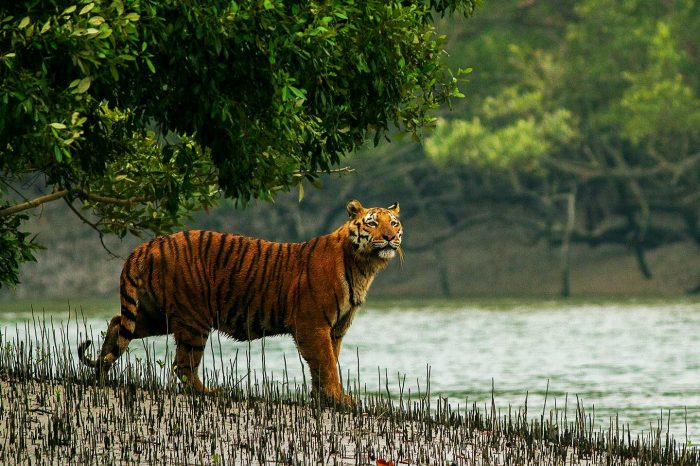
This is where Bengal’s soul lives. The Sundarbans – a UNESCO World Heritage Site and the world’s largest mangrove forest – spans approximately 10,000 sq km across India and Bangladesh, with roughly 4,260 sq km of core forest on the Indian side. It is home to approximately 100 Royal Bengal Tigers, Irrawaddy dolphins, saltwater crocodiles, Olive Ridley sea turtles, and over 300 bird species. The mangrove ecosystem here is the single most complex and biodiverse coastal habitat on Earth. The rivers – Matla, Gosaba, Thakuran – are tidal and treacherous, constantly shifting channels that have swallowed entire islands whole. Watching a winter sunrise over the Sajnekhali watchtower, with egrets rising from the silver reeds and the smell of salt in the air, is a moment that never leaves you.
The twin districts sit in the southern stretch of West Bengal, flanking the eastern side of the Hooghly River. North 24 Parganas borders Nadia and Murshidabad to the north, Bangladesh to the east, and Kolkata to the south. South 24 Parganas begins at Kolkata’s southern edge and stretches all the way to the Bay of Bengal, sharing a long international border with Bangladesh to the east. The entire region is part of the Ganges-Brahmaputra Delta – the world’s largest river delta – characterised by flat, low-lying terrain threaded with hundreds of tidal rivers, creeks, and channels. This geography makes the Parganas one of the most ecologically unique, and climatically vulnerable, places on the planet.
The twin Parganas experience a tropical climate – humid and hot summers (March to June), a heavy monsoon (July to September), and a pleasantly dry, cool winter (October to February). The best time to visit is October to March. For Sundarbans wildlife safaris, winter mornings between November and February are ideal – tigers are more active near the water’s edge, migratory birds fill the skies, and the morning mist over the tidal creeks gives the forest an otherworldly, almost dreamlike quality. Avoid the monsoon for Sundarbans travel – tidal flooding and rough river conditions make forest access dangerous and unpredictable.
By Road: Both districts are well connected by NH-12 and NH-112. Barasat, the administrative hub of North 24 Parganas, is just 22 km from Kolkata via the historic Jessore Road. For South 24 Parganas, the Diamond Harbour Road (SH-1) connects Kolkata to the southern coastal towns. State buses and private taxis run frequently from Kolkata’s Esplanade and Babughat bus terminals to all major destinations in both districts.
By Rail: Sealdah station in Kolkata is the main rail gateway into the Parganas. Two major suburban rail lines serve the districts – the Sealdah North Section (to Barasat, Bongaon, and Hasnabad) and the Sealdah South Section (to Diamond Harbour, Lakshmikantapur, and Namkhana). Trains run frequently and remain the most practical and scenic way to explore the region’s towns and coastal access points.
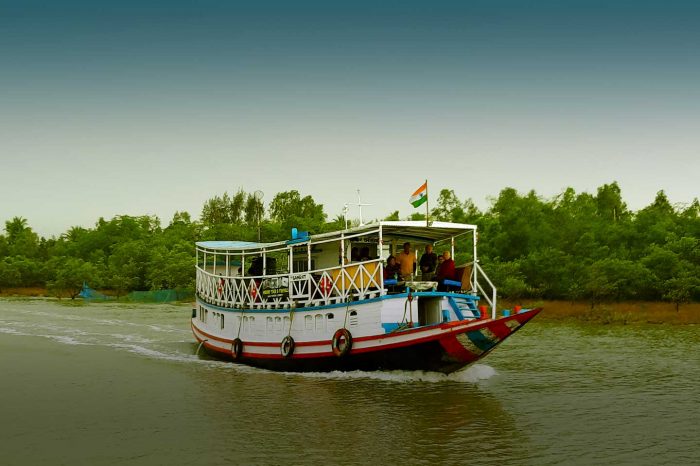
By Water: Uniquely among Indian districts, much of South 24 Parganas – particularly the Sundarbans and the southern coast – is accessible only by water. Government launches and private houseboats depart from Godkhali and Basanti into the forest waterways. From Kakdwip, ferries cross to Sagar Island. Here, the waterway is not simply transport – it IS the experience.
The history of the twin Parganas is inseparable from the history of Bengal itself. The region has been inhabited since antiquity – archaeological finds near the Hooghly estuary suggest pre-Mauryan settlements along the delta. The Palas, Senas, and Nawabs of Bengal ruled successively over this territory, leaving deep cultural and religious imprints on the delta’s character. The decisive turning point came in 1757 with the Battle of Plassey, after which the East India Company established dominance over Bengal – with the 24 Parganas becoming its very first territorial acquisition in India. Barrackpore became the military headquarters of British Bengal, and the region was the stage for the first flame of the 1857 uprising. Post-independence, the Partition of 1947 brought massive refugee influxes from East Bengal (now Bangladesh), fundamentally reshaping the demographic and cultural fabric of the Parganas – a trauma and a transformation that still echoes today. The twin districts now rank among the most densely populated in India, blending ancient Bengali traditions with the restless energy of proximity to Kolkata.
The Sundarbans is not just a destination – it is a force of nature. The world’s largest mangrove delta, shared between India and Bangladesh, is a UNESCO World Heritage Site and a Ramsar Wetland of International Importance. The Indian Sundarbans, located in South 24 Parganas, covers approximately 4,260 sq km of protected core forest. It is home to approximately 100 Royal Bengal Tigers – the most elusive, most powerful big cats on the planet. A boat safari through the narrow tidal creeks, with mangrove branches brushing the hull and the constant awareness that a tiger could be watching silently from the bank – this is wildlife experience at its most primal. The Sajnekhali Wildlife Sanctuary, Sudhanyakhali Watch Tower, and Dobanki Camp are the principal entry points. Beyond tigers, watch for saltwater crocodiles, spotted deer, wild boar, fishing cats, and the rare Irrawaddy dolphin gliding through the grey water.
At the very southern tip of South 24 Parganas, where the Ganges exhausts itself into the Bay of Bengal, lies Sagar Island. It is simultaneously one of Hinduism’s most sacred destinations and a beach of stark, windswept beauty. The Kapil Muni Temple here marks the legendary spot where King Bhagirath brought the Ganges down from the heavens. Every January, during Makar Sankranti, over a million pilgrims converge here for the Gangasagar Mela – a tide of human faith that is one of India’s most spectacular and moving sights. For the rest of the year, the island settles into a quiet, unhurried rhythm – flat green fields, coconut groves, the sound of the sea on all sides, and an absence of crowds that feels almost miraculous.
Diamond Harbour, on the west bank of the Hooghly where it widens into a broad tidal estuary, was once a Portuguese trading post and later a key British shipping anchorage. The name comes from the diamond-shaped bend in the river at this point. Today it is a popular weekend escape from Kolkata – a place to watch massive cargo ships navigate the river, eat the freshest hilsa at riverside restaurants, and walk the embankment at dusk as the sun turns the water gold. The ruins of the old fort and the lazy, unhurried character of the waterfront make Diamond Harbour feel like a town that time decided to leave gently alone.
Bakkhali is the most accessible beach in South 24 Parganas – a long, lonely stretch of grey-gold sand on the Bay of Bengal. It lacks the groomed infrastructure of Goa or Puri, which is precisely its appeal. The sea here is shallow and often rough, fringed by casuarina forests and working fishing villages where life runs on tide schedules, not train timetables. Adjacent Henry’s Island is a protected mangrove sanctuary with an eco-tourism camp run by the forest department – birdwatching here is exceptional, with painted storks, sea eagles, and half a dozen species of kingfisher. The two together make for a perfect, unhurried two-day coastal escape.
Barrackpore, on the banks of the Hooghly in North 24 Parganas, is where modern India was arguably born – in the fires of resistance. The 1857 Sepoy Mutiny was sparked here when Mangal Pandey refused the controversial greased cartridges and opened fire on his British officers. The Mangal Pandey Park marks the place of his execution and stands as one of the most quietly powerful historical sites in Bengal. The Gandhi Ghat on the Hooghly is one of the most serene riverside promenades in the state. The colonial cantonment, with its old churches, stately bungalows, and the Government House (now the Netaji Museum), reads like a textbook of 19th-century British Bengal brought to life in brick and plaster.
Canning is the gateway to the Sundarbans – a busy river town where the urban world ends and the delta begins. Named after Governor-General Lord Canning, it was once envisioned as a rival port city to Kolkata. That ambition never materialised, but Canning today is the most important embarkation point for Sundarbans forest safaris. From Basanti, further south into the delta, the landscape transforms entirely – water, mangrove, and open sky in every direction, with no clear boundary between river and forest. This is where you board the launches that carry you deeper into one of the world’s last great wildernesses.
Kakdwip is the ferry crossing point for Sagar Island, a short boat ride across the river mouth. It is also one of the busiest fishing towns on the Bengal coast – the Kakdwip Fishing Harbour hums with activity before dawn, and watching the trawler fleet return in a blaze of colour and noise is a spectacle no camera can fully capture. Namkhana, the terminus of the Sealdah South rail line, is the access hub for both Bakkhali beach and Henry’s Island, making it the practical gateway for exploring South 24 Parganas’ entire coastal strip.
98742 84569
98743 61951
Mon-Sat 11.00AM-07.30PM