

- Home
- INDIA
- Offbeat India
- International
- Theme Tours
- Handpicked
- Plan Your Trip
Nadia
Nadia – A Journey to the Land of Saints, Scholars & Rivers Spiritual, Scholarly, Serene – Nadia. A magical confluence of rivers and revelations, where saffron-robed devotees and white-clad scholars walk the same ancient lanes. A land where grand temples […]
Nadia – A Journey to the Land of Saints, Scholars & Rivers
Spiritual, Scholarly, Serene – Nadia.
A magical confluence of rivers and revelations, where saffron-robed devotees and white-clad scholars walk the same ancient lanes. A land where grand temples rise from the riverbanks and the air hums with kirtan, Sanskrit chanting, and the clatter of handloom looms. Nadia embodies the perfect fusion of faith, folklore, and fine craftsmanship – a quietly extraordinary district that has witnessed epochal battles, birthed spiritual revolutions, and nurtured Bengal’s most brilliant minds for centuries.
Nadia Tourism: A Quick View of the District
Headquarters: Krishnanagar
Official Language: Bengali
Dial Code: 03472 (Krishnanagar)
Population: 5,168,488 (as of 2011 Census)
Currency: Indian Rupee (INR)
Time Zone: UTC+05:30 (IST)
Area: 3,927 square km
Highlights of Nadia Tourism: Through the Looking Glass
Historical Lens
To truly understand Nadia, you must walk its history. This district was once the beating intellectual heart of Bengal – famously called the “Oxford of the East” – drawing Sanskrit scholars from across the subcontinent to the legendary Navya Nyaya school of philosophy in Nabadwip. The Palashi (Plassey) Memorial stands on the very ground where, in 1757, the Battle of Plassey sealed India’s colonial fate – Robert Clive’s triumph over Siraj ud-Daulah that handed the subcontinent to the British East India Company. The Krishnanagar Rajbari speaks of the Maharaja who patronised Ramprasad Sen, one of Bengal’s greatest devotional poets. Every brick of Nadia is a page from a book that changed India forever.
Architectural Lens
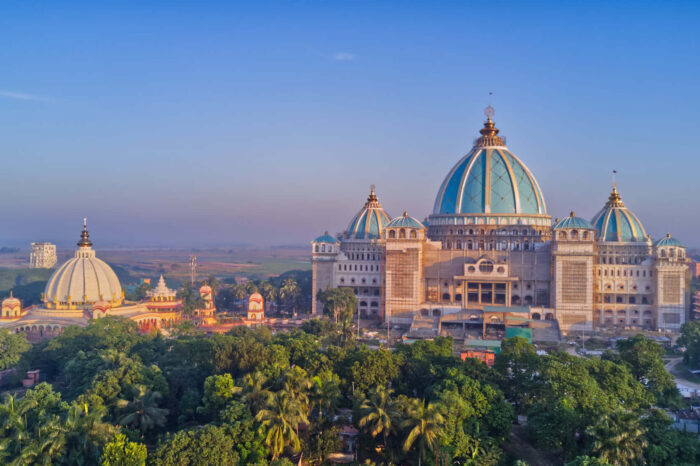
Nadia may not have the towering stone forts of Rajasthan, but it has something equally captivating – temples, ghats, and palaces that blend Bengal’s terracotta tradition with Mughal grace. The ISKCON Chandrodaya Mandir in Mayapur, when complete, will be the tallest religious structure in the world – a monument to devotion of cosmic ambition. The ancient terracotta temples of Nabadwip, carved with scenes from the Puranas and Ramayana, are masterpieces of the Bishnupur school of architecture. The Krishnanagar Rajbari, though faded by time, carries the echo of a royal court that gave Bengal some of its finest art and music. The riverside ghats of Nabadwip, lined with old mandirs and ashrams, make for one of the most atmospheric walks in West Bengal.
Religious Lens
Nadia is arguably one of the holiest districts in all of India. Nabadwip is the birthplace of Sri Chaitanya Mahaprabhu (1486 AD), the saint who ignited the Bhakti movement across Bengal and Odisha and whose influence stretches as far as Europe and America today. Mayapur, just across the Bhagirathi, is the global headquarters of ISKCON – the International Society for Krishna Consciousness – drawing hundreds of thousands of pilgrims every year. The Nabadwip Dham parikrama (a sacred circumambulation of nine islands) is one of Vaishnavism’s most important pilgrimages. Shantipur is home to numerous ancient Vaishnava temples connected to Advaita Acharya, one of Chaitanya’s closest associates. Nadia is not just a district – it is a living, breathing pilgrimage.
Cultural Lens
Nadia is a loom of culture, weaving together thread, clay, music, and memory. Shantipur and Phulia are celebrated worldwide for Tant sarees – fine cotton handloom weaves that are as light as a whisper and as intricate as a poem. Krishnanagar is the home of the legendary clay modellers whose lifelike figures have been exhibited internationally and whose craft traces back over 300 years. The district breathes Baul music – the mystic folk tradition of Bengal that UNESCO has recognised as an Intangible Cultural Heritage of Humanity. From the sound of the ektara drifting across a river at dusk to the sight of women setting up looms at dawn, Nadia’s culture is a sensory experience that stays with you long after you leave.
Festive Lens
Nadia’s festivals are as vivid as its history. Jagadhatri Puja in Krishnanagar is the district’s grandest celebration – a five-day festival of breathtaking idol artistry and illuminated processions that rivals Kolkata’s Durga Puja in scale and devotion. The Dol Yatra (Holi) in Nabadwip is legendary – a seven-day festival of colour, kirtan, and procession where the entire town surrenders to joy. Mayapur hosts Gaura Purnima – the birthday of Sri Chaitanya – attended by devotees from over 100 countries, turning this small town into an international city of song and worship. The Ratha Yatra (Chariot Festival) in Krishnanagar is another spectacular event, with massive chariots pulling through the streets amid thousands of devotees.
Nature’s Lens
Nadia is a district of rivers – the Bhagirathi (Ganges), Jalangi, Churni, and Mathabhanga flow through it like veins, giving life to its soil, its spirituality, and its stories. The Bethuadahari Wildlife Sanctuary, the only wildlife sanctuary in Nadia, is a lush forest reserve home to spotted deer, rhesus macaques, pythons, and over 100 species of birds. The char lands (river islands) along the Bhagirathi offer a raw, unhurried nature experience – ideal for birdwatching and peaceful boat rides. The wetlands and jheels (ponds) scattered across the district are magnets for migratory birds in winter. For travellers who like their nature quiet, contemplative, and unhurried, Nadia delivers.
Interesting Facts about Nadia – Forgotten Fables
- The Battle of Plassey (1757) fought in Palashi, Nadia, is considered the event that gave Britain an empire – arguably the most consequential battle in modern South Asian history.
- Nabadwip was once home to Raghunath Shiromani and other stalwarts of the Navya Nyaya school of logic – a philosophical tradition so advanced it is being re-studied by Western academics today.
- The ISKCON Chandrodaya Mandir in Mayapur, currently under construction, is designed to stand 113 metres tall – taller than the Statue of Liberty – making it the world’s tallest religious structure.
- Krishnanagar’s clay dolls are so realistic they have reportedly been mistaken for real people. The craft is over 300 years old and was patronised by Maharaja Krishnachandra.
- Shantipur’s Tant sarees are woven with a count as fine as 100 threads per inch – a skill passed down through generations of weaving families for over 500 years.
Location of Nadia
Nadia is located in the southern part of West Bengal, in eastern India. It shares borders with Murshidabad to the north, Bangladesh to the east, North 24 Parganas to the south, and Purba Bardhaman and Hooghly to the west. The district sits at the confluence of the Bhagirathi (Ganges) and Jalangi rivers, a geography that has shaped its culture, trade, and spirituality for thousands of years. Its proximity to Kolkata – just 80-100 km away – makes it an ideal and often-overlooked extension of any visit to the city.
Best Time to Visit Nadia
Nadia has a tropical monsoon climate with hot, humid summers and cool winters. The best time to visit is from October to March, when temperatures are comfortable (15°C-28°C), the rivers are at their most beautiful, and the festival calendar is at its most vibrant. Avoid May and June when temperatures can cross 40°C and humidity is oppressive. The Gaura Purnima festival in March (at Mayapur) and Jagadhatri Puja in November (at Krishnanagar) are the two unmissable events that draw visitors from across the globe.
How to Get to Nadia
By Road: Nadia is well connected by National Highway 12 (Kolkata-Krishnanagar-Berhampore). State highways and district roads link all major towns. Regular bus services run from Kolkata’s Esplanade and private taxis make for an easy 2-3 hour drive from the city.
By Rail: Nadia is superbly connected by train. The Sealdah-Krishnanagar and Sealdah-Ranaghat railway lines run frequent services throughout the day. Nabadwip Dham and Mayapur are also accessible by rail, with boats ferrying passengers across the river. The train is the most scenic and comfortable way to arrive.
By Flight: The nearest airport is Netaji Subhas Chandra Bose International Airport, Kolkata – approximately 80-100 km from Krishnanagar. Kolkata is well connected to all major Indian cities and several international destinations. From the airport, taxis and trains provide easy onward access to Nadia.
History of Nadia
Nadia’s history is layered like the silt of its rivers – ancient, rich, and constantly replenished. The district was a premier centre of Sanskrit learning during the medieval period, producing scholars and philosophers of international repute under the Sena dynasty and later under local Brahmin patronage. In 1486, Nabadwip witnessed the birth of Sri Chaitanya Mahaprabhu, an event that triggered one of the most powerful devotional movements in Indian history. In 1757, the plains of Palashi (Plassey) became the site of a battle that transformed not just Bengal but the entire world – marking the beginning of British colonial dominance in India. Under the influence of the Krishnanagar royal family, Nadia became a major patron of arts, crafts, and culture in the 18th and 19th centuries. Today, Nadia stands as a district where that history is not archived but alive – in its temples, its looms, its festivals, and its rivers.
With its spiritual depth, cultural richness, and quiet natural beauty, Nadia offers travellers something rare: an authentic encounter with Bengal’s soul. Whether you come as a pilgrim, a history lover, a craft enthusiast, or simply a curious wanderer, Nadia will give you more than you came looking for.
Nadia
If you want to experience the soul of Bengal – unfiltered, unhurried, and unforgettable – then Nadia is the place to go. The gentle rivers, the ancient temple towns, the world-famous handloom lanes, the vibrant kirtan echoing at dawn, and the clay figures that seem to breathe make Nadia a quietly extraordinary destination. This is not a place of grand spectacle – it is a place of deep resonance. When you travel through Nadia, you don’t just see Bengal, you feel it.
The district spans several distinct towns and landscapes, each with its own personality. Planning your time wisely is the first step to unlocking this place fully. Here is a closer look at the key destinations within Nadia.
Nabadwip (Nabadwip)
Nabadwip is Nadia’s most sacred town and one of Vaishnavism’s holiest pilgrimage sites. Set on the western bank of the Bhagirathi, this ancient town of nine islands (nava = nine, dwip = island) was once the greatest seat of Sanskrit scholarship in Bengal. It is the birthplace of Sri Chaitanya Mahaprabhu (born 1486 AD), the saint-philosopher whose teachings of devotional love and communal kirtan singing swept through Bengal, Odisha, Vrindavan, and eventually the entire world through ISKCON. Nabadwip’s ghats are alive at all hours – with chanting, bathing pilgrims, and the orange flame of evening aartis. The Nabadwip Dham Parikrama, a sacred circuit of the nine islands performed over five days, draws tens of thousands of devotees each year. Beyond its spiritual gravity, the town has a timeless, unhurried quality – narrow lanes, ancient temples, and the quiet soundtrack of the river – that makes it one of the most atmospheric places in West Bengal.
Mayapur
Mayapur sits just across the Bhagirathi from Nabadwip, connected by ferry, yet it feels like a world unto itself. This is the global headquarters of ISKCON – the International Society for Krishna Consciousness – founded by Srila Prabhupada in 1966. Every year, hundreds of thousands of devotees from over 100 countries descend on this small town, making it one of India’s most internationally diverse pilgrimage destinations. The existing ISKCON temple complex is a dazzling blend of marble, mosaic, and devotional fervour. But the real marvel is under construction: the Chandrodaya Mandir – a 113-metre-tall Vedic temple that, upon completion, will be the tallest religious structure in the world. The Gaura Purnima festival (March) transforms Mayapur into a city of lights, music, and thousands of devotees from every corner of the globe. If Nabadwip is Bengal’s spiritual heartbeat, Mayapur is its global amplifier.
Krishnanagar
Krishnanagar is the district headquarters of Nadia and its most urbane town. Named after Maharaja Krishnachandra – the 18th-century king who was one of Bengal’s greatest patrons of art – this town is the home of the legendary Krishnanagar clay modellers. Their craft is extraordinary: lifelike figurines of such astounding realism that they have been exhibited in London and across the world. The town’s Ghurni area is essentially an open workshop, where families of sculptors carry forward a tradition that is over 300 years old. Krishnanagar is also the epicentre of Jagadhatri Puja – a five-day festival in November where the craftsmanship of idol-making, the grandeur of illuminated tableaux, and the fervour of thousands of devotees combine to create something unforgettable. The Krishnanagar Rajbari (royal palace), though weathered, still holds the regal memory of a court that shaped Bengal’s intellectual and artistic golden age.
Shantipur & Phulia
Shantipur and its neighbouring town Phulia are the weaving capitals of Nadia – and arguably of Bengal. For over 500 years, the master weavers of these towns have been creating Tant sarees: fine cotton weaves, gossamer-light, with intricate borders and motifs that are the pride of every Bengali woman’s wardrobe. Walking through Shantipur’s lanes, you hear the rhythmic clack of handlooms before you see them – every household is a workshop, every doorway a glimpse into a living textile tradition. The weavers of Shantipur hold a GI (Geographical Indication) tag for their craft, confirming its authenticity and heritage. Shantipur is also home to ancient Vaishnava temples connected to Advaita Acharya, one of Sri Chaitanya’s closest companions. Here, the loom and the temple coexist – the town weaves its devotion into its fabric, quite literally.
Palashi (Plassey)
Palashi is a small town that carries the weight of an enormous moment in history. On 23 June 1757, the Battle of Plassey was fought on the mango groves of this riverine landscape, between the forces of the Nawab of Bengal, Siraj ud-Daulah, and the British East India Company under Robert Clive. The Nawab’s defeat – partly due to the treachery of his general Mir Jafar – opened the gates to over 190 years of British colonial rule in India. A memorial column at the battlefield site marks this defining moment. The atmosphere here is unexpectedly serene – mango groves, the quiet river, birdsong – which makes the weight of history feel even more profound. A visit to Palashi is not a typical tourist experience; it is a moment of historical reckoning that every traveller who cares about South Asian history should make.
Kalyani
Kalyani is Nadia’s most planned and modern town, built after Indian independence as a model satellite city. Home to Kalyani University, it has a calm, garden-city character with wide tree-lined roads and a thoughtful layout. It serves as a good base for travellers exploring southern Nadia and is particularly convenient given its excellent rail connectivity to Kolkata (about 50 km away on the Sealdah-Krishnanagar line). Kalyani is not a heritage destination in the traditional sense, but its university, medical infrastructure, and green landscape make it a comfortable and practical town to include in any Nadia itinerary.
Bethuadahari Wildlife Sanctuary
For the nature lover in your travel group, Bethuadahari is Nadia’s green escape. This compact but rich wildlife sanctuary – the only one in the district – covers about 67 hectares of dense forest in the Tehatta block of Nadia. It is home to spotted deer (chital), barking deer, rhesus macaques, Indian pythons, monitor lizards, and a remarkable diversity of bird life including migratory species in winter. The forest is crossed by a stretch of National Highway, and the sight of deer grazing right beside the road is both surreal and delightful – like nature reclaiming its right of way. The sanctuary is best visited in the cool morning hours between October and February for optimal wildlife and bird sightings.
Experiences
- The 10 Best Japan Festivals for Indian Travellers
 August 24, 2026
 - The Ultimate Japan Travel Guide: 17 Must-Visit Destinations
 August 17, 2026
 - Wine Tourism in India
 June 8, 2026
 - Anini Tour
 June 5, 2026
 - Tamia Hills Tour
 June 4, 2026
Call
98742 84569
98743 61951
Mon-Sat 11.00AM-07.30PMNewsletter
Uncategorized
- Tours in BlogApril 6, 2026
- Tours in Blog
- Required plugin "Meks Easy Photo Feed Widget" is required. Please install the plugin here. or read more detailed instruction about How to setup the plugin here
Connect to Us
Recent Tours
Rate & Review Us
Contact Info
- +91 98742 84569
- experience@ocean6.in
- 16, Suren Tagore Rd, Ekdalia, Ballygunge, Kolkata, West Bengal 700019
- Mon - Sat : 11.00 AM - 7.30 PM
Sunday : CLOSED
Newsletter
Quick Links
