

- Home
- INDIA
- Offbeat India
- International
- Theme Tours
- Handpicked
- Plan Your Trip
Bankura
Bankura – A Journey to Bengal’s Terracotta Kingdom Earthy, Eternal, Enchanting – Bankura. A land where russet-red temples rise from laterite soil like prayers frozen in clay. Where the iconic Bankura Horse – tall, graceful, and eternally silent – has […]
Bankura – A Journey to Bengal’s Terracotta Kingdom
Earthy, Eternal, Enchanting – Bankura.
A land where russet-red temples rise from laterite soil like prayers frozen in clay. Where the iconic Bankura Horse – tall, graceful, and eternally silent – has stood guard over Bengal’s artistic soul for centuries. Bankura is West Bengal’s best-kept secret: a district where dense Sal forests whisper ancient tribal tales, the Kangsabati river mirrors emerald skies, and terracotta temples narrate stories no manuscript can fully capture. This is not just a destination – it is a living museum, an artist’s canvas, and a nature lover’s sanctuary, all woven into one. Bankura embodies the perfect fusion of craft, culture, and countryside, creating a timeless landscape that has witnessed the rise of kingdoms, heard the rhythm of classical ragas, and held the fingerprints of master artisans across centuries.
Bankura Tourism: A Quick View of the District
District Headquarters: Bankura Town
Official Language: Bengali
Dial Code: 03242
Population: 3,596,292 (as of 2011)
Currency: Indian Rupee (INR)
Time Zone: UTC+05:30 (IST)
Area: 6,882 square km
Highlights of Bankura Tourism: Through the Looking Glass
Historical Lens
To truly experience the essence of Bankura, you must walk its ancient grounds with the curiosity of an archaeologist. The Bishnupur Museum is a treasure trove – housing a rare collection of terracotta plaques, Malla-era coins, and inscribed copper plates that open a vivid window into medieval Bengal. The Archaeological Survey of India site at Bishnupur preserves evidence of a civilization that flourished from the 7th century onwards. Most striking of all is the Susunia Hill rock inscription of King Chandra Varman – etched in the 4th century AD – one of the oldest known Sanskrit inscriptions from Bengal, carved into stone like a king’s permanent signature on history.
Architectural Lens
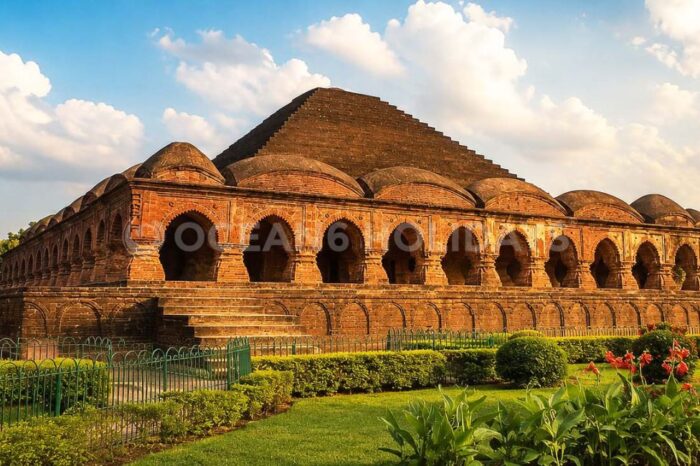
Bankura is rightfully called the “Land of Terracotta Temples.” Nowhere else in India will you find such a dense cluster of medieval temples built entirely from hand-moulded terracotta brick. The Rasmancha in Bishnupur, built in 1600 AD by Malla King Hambir, is the oldest brick temple in West Bengal – a bold pyramidal structure with 108 arched verandahs. The Jorbangla Temple, with its signature twin-hut roof, is an architectural metaphor for duality – two halves completing one whole. The Shyam Rai Temple stuns with its five towering spires and intricate panels depicting scenes from the Ramayana and Mahabharata. These are not merely temples – they are textbooks in brick, each panel a frozen chapter of mythology.
Religious Lens
Faith runs deep in Bankura’s red soil. The Biharinath Temple, perched atop Biharinath Hill, is a revered Shiva shrine drawing thousands of devotees – especially during Shivaratri, when pilgrims climb the rocky path in darkness to offer prayers at dawn. The Mrinmoyee Temple in Bishnupur hosts one of Bengal’s oldest Durga Pujas, believed to have been celebrated continuously for over 1,000 years – a tradition that predates most living institutions in the country. The Joychandi temple on Joychandi Hill, near the Purulia border, is a site of deep tribal and Hindu religious significance. In Bankura, divinity is not confined to grand shrines – small roadside temples draped in red fabric appear at every village bend, reminding you that faith here is local, personal, and ever-present.
Cultural Lens
Bankura is a cultural powerhouse wrapped in quiet modesty. The Bishnupur Gharana of Hindustani classical music – one of India’s most distinguished musical lineages – was born here, in the royal courts of the Malla kings. Its Dhrupad and Kheyal traditions have shaped the very spine of Indian classical music for over 400 years. The iconic Bankura Horse – a terracotta figure with a long, arched neck and proud stance – is not merely a craft item; it is the official symbol of West Bengal, appearing on the state’s emblem. The Baluchari Silk Sarees of Bishnupur are wearable epics – woven with mythological narratives in silk thread. Add the vibrant Baul folk music, the Chhau dance from the district’s borders, and the living Santhali tribal art traditions, and Bankura becomes a cultural festival that never ends.
Festive Lens
Bankura’s festivals are the living heartbeat of the district. The Bishnupur Mela, held every December-January, is a grand celebration of art, craft, and music that draws connoisseurs from across India – master craftsmen display terracotta art, Baluchari sarees, dokra metal castings, and brass work. The Joychandi Mela, held twice a year, is a massive tribal and rural fair where thousands gather to trade, sing, and celebrate. Rash Purnima in Bishnupur is celebrated with extraordinary devotion – the temples are illuminated, and the entire town transforms into a glowing night of classical music and dance. These are not staged tourist events – they are the living breath of a culture that has never stopped burning bright.
Nature’s Lens
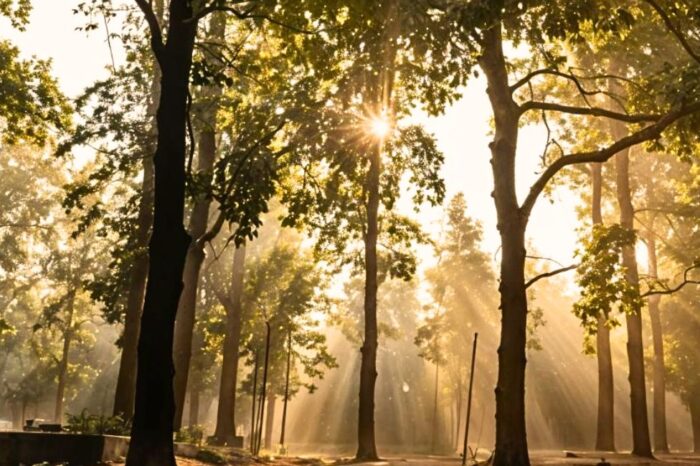
Bankura’s landscape is a beautiful contradiction – laterite plateaus that glow deep red at sunset, dense Sal and Mahua forests sheltering leopards and sambars, and sparkling reservoirs mirroring open sky. The Mukutmanipur reservoir – formed by the Kangsabati and Kumari rivers – is surrounded by forested hills and offers tranquil boating on glassy waters. The Jhilimili forest, cloaked in Sal trees and home to Santhali tribal communities, is a sanctuary of raw, unhurried nature. Susunia Hill offers trekking trails through rocky terrain and wooded slopes. For birding enthusiasts, Bankura’s wetlands and forest edges are year-round treasure troves.
Interesting Facts about Bankura – Forgotten Fables
- The Bankura Horse – a stylized terracotta horse with a long, arched neck – is the official symbol of West Bengal and one of India’s most recognized folk art icons worldwide.
- Bishnupur’s Rasmancha, built in 1600 AD, is the oldest laterite brick temple in West Bengal, constructed by Malla King Hambir with 108 arched verandahs in a unique pyramidal form.
- The Bishnupur Gharana is one of India’s rarest surviving Hindustani classical music traditions, tracing its lineage directly to the Malla royal court of medieval Bengal.
- The Kangsabati Dam at Mukutmanipur is one of the longest earthen dams in the world, stretching over 10,000 feet – an engineering feat wrapped in natural beauty.
- The Susunia Hill inscription of King Chandra Varman, dating to the 4th century AD, is one of the oldest known Sanskrit inscriptions from Bengal – older than most of the region’s recorded history.
Location of Bankura
Bankura is located in the western part of West Bengal, sitting on the eastern fringe of the Chota Nagpur Plateau – a zone where Bengal’s flat alluvial plains meet the rocky highlands of Jharkhand, creating a uniquely dramatic landscape. It borders Purba and Paschim Bardhaman to the north and northeast, Hooghly to the east, Jhargram to the south, and Purulia to the west. This geographical position – between the plains and the plateau – has shaped Bankura’s distinct identity: part Bengal, part tribal heartland, wholly extraordinary.
Best Time to Visit Bankura
October to March is the ideal window. Winters are cool and dry – perfect for temple exploration, trekking Susunia Hill, and boating at Mukutmanipur. The Bishnupur Mela in December-January is an absolute must. Monsoon (June-September) turns the forests and hills lush green, with waterfalls coming alive – visually stunning, though roads can get challenging. Avoid April-June; the laterite plateau heats up fiercely, often crossing 40°C.
How to Get to Bankura
By Road: Bankura is well-connected via NH-14 and state highways. Direct buses run from Kolkata’s Esplanade Bus Terminus – a journey of approximately 5-6 hours. Private taxis and cabs offer comfortable point-to-point travel through picturesque countryside.
By Rail: Bankura Town has its own railway station on the South Eastern Railway network, with regular trains connecting to Kolkata (Howrah), Purulia, and Kharagpur. The heritage Bankura-Damodar River (BDR) narrow gauge railway – winding through tribal villages and Sal forests – is a scenic journey worth taking purely for the experience.
By Flight: The nearest airport is Netaji Subhas Chandra Bose International Airport in Kolkata, approximately 220 km away. From Kolkata, road or rail easily connect to Bankura in under 6 hours.
History of Bankura
Bankura’s history is as layered as its laterite soil. The Susunia Hill inscription reveals that the region was politically active as early as the 4th century AD under King Chandra Varman. From the 7th century onward, the Malla dynasty established Bishnupur as their capital and transformed it into a cultural powerhouse of medieval Bengal. Over the next 11 centuries, the Malla kings – remarkable patrons of art, music, and architecture – commissioned over 30 terracotta temples, establishing what would become one of India’s most unique artistic traditions. Bankura’s tribal communities – the Santhals, Mundas, and Bhumijs – have inhabited its forests for millennia, maintaining traditions that predate recorded history altogether. During the Mughal period, Bishnupur remained a sovereign kingdom, even repelling Maratha invasions. Under British rule, Bankura became part of the Bengal Presidency. Post-independence in 1947, it was incorporated into West Bengal. Today, Bankura stands as a proud keeper of Bengal’s artistic, tribal, and architectural heritage – understated in ambition, extraordinary in legacy.
Bankura
If you want to experience Bengal beyond the tourist brochure, Bankura is where you come. Not the Kolkata of colonial grandeur or the Darjeeling of mountain mist – but the Bengal of earth and fire, of hands that shape clay into icons, of voices that sing ragas older than nations. Bankura is where the Bankura Horse was born, where terracotta temples outnumber tourist buses, and where a leopard might cross your path on the way to a 400-year-old shrine. The district’s towns and villages are pages in a living book – each one a different chapter of Bengal’s deepest identity. We hope to give you some meaningful insights into the major places and sights this remarkable district has to offer.
Bishnupur
Bishnupur is the crown jewel of Bankura – an open-air museum where every structure is an exhibit. Founded as the Malla capital in the 7th century and reaching its cultural peak between the 17th and 18th centuries, Bishnupur is home to the most extraordinary concentration of terracotta temples in India. The Rasmancha – built in 1600 AD – anchors the town with its pyramidal mass and 108 arched verandahs. The Jorbangla Temple, with its elegant twin-hut roof, looks like two friends leaning into each other for support. The Shyam Rai Temple dazzles with five spires and wall-to-wall terracotta panels depicting Krishna’s Leela, epic battles, and village life frozen in clay. Beyond the temples, Bishnupur is the birthplace of Baluchari silk sarees – woven epics in fabric – and the Bishnupur Gharana of Hindustani music. Walk its lanes and you will find craftsmen still hand-shaping the iconic Bankura Horse, keeping a centuries-old tradition breathing with every pinch and press of their fingers.
Mukutmanipur
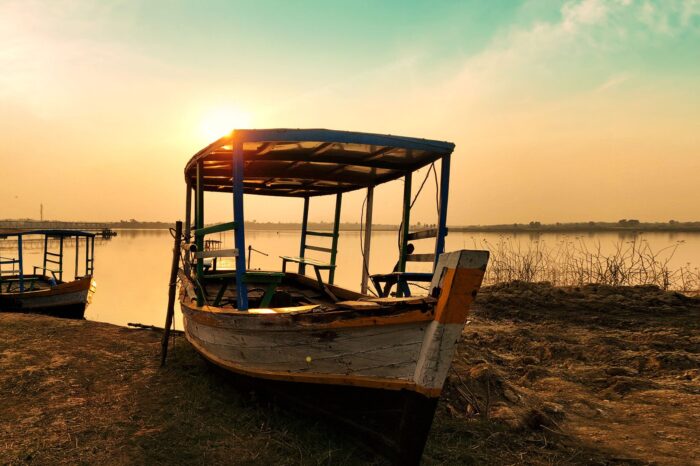
Mukutmanipur is Bankura’s answer to silence. It is where the Kangsabati and Kumari rivers merge behind one of the world’s longest earthen dams, creating a vast, shimmering reservoir embraced by forest-covered hills. Boating at dawn on these still waters – with mist rolling off the hills and the forest just waking up – is one of Bengal’s most quietly spectacular experiences. Tribal hamlets dot the surrounding hillsides, and the forest shelters spotted deer, peacocks, and a rich variety of birds. For the traveler exhausted by noise and pace, Mukutmanipur is a reset button. No crowds, no rush, just water, hill, and sky.
Susunia Hill
Susunia Hill is Bankura’s great outdoors playground and its most surprising historical site rolled into one. Rising to about 440 metres, it is famous for rock climbing – its granite boulders and cliff faces draw enthusiasts from across West Bengal. But history ambushes you here too: the Susunia rock inscription, carved in the 4th century AD by King Chandra Varman, is one of Bengal’s oldest archaeological treasures, hiding in plain sight on a hillside. A perennial mountain stream flows through the rocky terrain, and the view from the top – of endless red-and-green laterite landscape stretching to the horizon – makes every metre of the climb worthwhile.
Jhilimili
Jhilimili is where the forest takes complete control. A dense tract of Sal, Mahua, and Kendu trees, it is home to the Santhali tribal community whose life, art, and music have remained largely intact across centuries. The forest is ideal for eco-tourism, nature walks, and birdwatching. At night, the villages glow with firelight and the air fills with folk song – a world that feels entirely removed from modern India. If Bankura is the destination for culture, Jhilimili is the destination within the destination – raw, real, and deeply moving.
Biharinath Hill
At 448 metres, Biharinath is the highest peak in Bankura district. A Shiva temple at its summit makes it a revered pilgrimage site – during Shivaratri, thousands of devotees climb the rocky path in pre-dawn darkness to offer prayers at sunrise. For non-pilgrims, the hill offers trekking trails, panoramic views, and remarkable solitude. The surrounding forest is a buffer zone teeming with wildlife – leopard sightings have been reported by locals. Sunrise from the summit – when the laterite plateau turns gold and the forests below dissolve in mist – is Bankura at its most spectacular.
Bankura Town
The district headquarters is a quiet, unpretentious town that wears its identity lightly but carries it with pride. The Bankura Horse – those elegant terracotta horses you may have seen in government offices, museum lobbies, and craft fairs across India – is made here, in small workshops on the town’s outskirts. A visit to these workshops is a masterclass in focused artistry: bare hands, raw clay, and a few simple tools creating an object that represents an entire state. The town also carries a charming colonial-era character – old buildings, tree-lined streets, and a pace of life that quietly insists you slow down and pay attention.
Gangajalghati
Gangajalghati is Bankura’s hidden waterfall escape. Nestled in the forest belt near the Damodar river basin, it is a favourite among locals for picnics, nature walks, and simply sitting by the water. The seasonal waterfalls here are at their most dramatic during and after the monsoon, when the rocky hillsides come alive with rushing water. Far from the tourist circuit, Gangajalghati rewards those who seek it out with peace, greenery, and the kind of unspoiled natural beauty that is getting increasingly rare to find.
Ocean6 Holidays | Destination Guide – Bankura, West Bengal
For customized Bankura tour packages, contact Ocean6 Holidays.
Experiences
- The 10 Best Japan Festivals for Indian Travellers
 August 24, 2026
 - The Ultimate Japan Travel Guide: 17 Must-Visit Destinations
 August 17, 2026
 - Wine Tourism in India
 June 8, 2026
 - Anini Tour
 June 5, 2026
 - Tamia Hills Tour
 June 4, 2026
Call
98742 84569
98743 61951
Mon-Sat 11.00AM-07.30PMNewsletter
Uncategorized
- Tours in BlogApril 6, 2026
- Tours in Blog
- Required plugin "Meks Easy Photo Feed Widget" is required. Please install the plugin here. or read more detailed instruction about How to setup the plugin here
Connect to Us
Recent Tours
Rate & Review Us
Contact Info
- +91 98742 84569
- experience@ocean6.in
- 16, Suren Tagore Rd, Ekdalia, Ballygunge, Kolkata, West Bengal 700019
- Mon - Sat : 11.00 AM - 7.30 PM
Sunday : CLOSED
Newsletter
Quick Links
