

- Home
- INDIA
- Offbeat India
- International
- Theme Tours
- Handpicked
- Plan Your Trip
Kolkata
Kolkata Tour Packages
Kolkata – A Journey to the City of Joy Cultural, Colonial, Captivating – Kolkata. A city that breathes literature, bleeds football, and lives for its art. Kolkata is India’s most unapologetically alive metropolis – where the aroma of freshly brewed […]
Kolkata – A Journey to the City of Joy
Cultural, Colonial, Captivating – Kolkata.
A city that breathes literature, bleeds football, and lives for its art. Kolkata is India’s most unapologetically alive metropolis – where the aroma of freshly brewed chai mingles with the smell of old books on College Street, where trams rattle past crumbling colonial mansions, and where the Hooghly River holds the reflections of a thousand years of poetry. This is not just a city. It is a feeling. Grand yet intimate, chaotic yet deeply philosophical, Kolkata is the soul of India dressed in white kurtas and crowned with marigolds. The City of Joy earns its name not from its wealth, but from its warmth – the kind that wraps you like a shawl on a winter morning and stays with you long after you leave.
Kolkata Tourism: A Quick View of the City
State Capital: Kolkata (Capital of West Bengal)
Official Language: Bengali
Dial Code: 033
Population: 14,112,536 (City, as of 2011)
Currency: Indian Rupee (INR)
Time Zone: UTC+05:30 (IST)
Area: 205 square km (City)
Highlights of Kolkata Tourism: Through the Looking Glass
Historical Lens
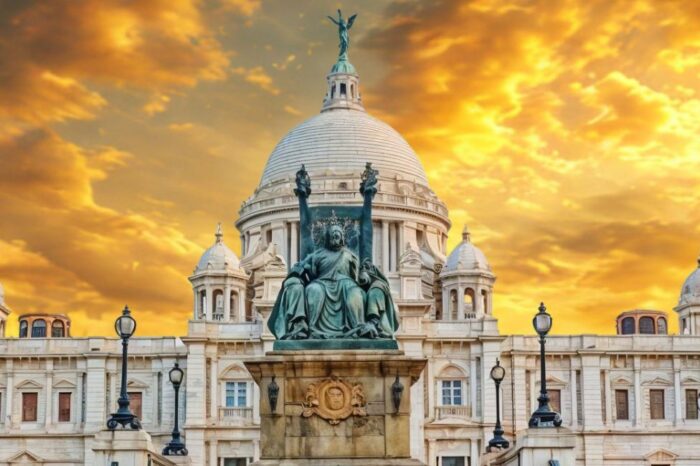
To truly understand Kolkata, you must walk through its layered past – a past that shaped the destiny of an entire subcontinent. The Indian Museum on Chowringhee Road is one of the oldest and largest museums in Asia, housing rare artefacts, fossils, Mughal paintings, and ancient coins that span centuries of civilization. The Victoria Memorial is Kolkata’s crown jewel – a grand white marble monument built in memory of Queen Victoria that now stands as a museum showcasing the British Raj era through rare paintings, manuscripts, and sculptures. The Netaji Bhawan in Elgin Road is the ancestral home of freedom fighter Netaji Subhas Chandra Bose, now a museum preserving the relics of India’s most daring independence hero. These are not just buildings – they are time capsules of an era that shaped modern India.
Architectural Lens
Kolkata is India’s finest open-air museum of colonial architecture. Known as the “City of Palaces,” it wears its built heritage with both pride and a certain graceful decay. The Marble Palace in Shyambazar is a 19th-century aristocratic mansion packed with European sculptures, Ming vases, and Victorian furniture – a testament to the opulence of Bengal’s zamindars. The iconic Howrah Bridge (Rabindra Setu), a cantilever truss bridge with no nuts or bolts, stands as an engineering marvel – over 80,000 vehicles and countless pedestrians cross it every single day. The Writers’ Building, once the headquarters of the British East India Company, and the grand General Post Office built on the ruins of the original Fort William, speak volumes of Kolkata’s colonial grandeur. And scattered through North Kolkata, the crumbling paras (neighbourhoods) filled with ornate terracotta havelis are architecture walking quietly toward oblivion – and must be seen before they are gone.
Religious Lens
Kolkata’s religious landscape is as plural and layered as its people. The Kalighat Temple, dedicated to the goddess Kali and believed to be one of the 51 Shakti Peethas, draws tens of thousands of devotees daily. Its raw, ancient energy is unlike anything else in the city. The Dakshineswar Kali Temple, built by Rani Rashmoni in 1855 and made famous by saint Ramakrishna Paramahamsa, sits beautifully on the banks of the Hooghly River and radiates spiritual calm. St. Paul’s Cathedral, a Gothic Revival masterpiece, and the Armenian Church of the Holy Nazareth – one of the oldest churches in India – reflect Kolkata’s embrace of Christianity and its Armenian merchant community dating back to the 1700s. The Nakhoda Mosque, inspired by Mughal architecture and capable of holding 10,000 worshippers, and the Pareshnath Jain Temple with its mirrorwork and stained glass, together paint a picture of a city where every faith has always had a home.
Cultural Lens
If India has a cultural capital, it is Kolkata. This is the city of Rabindranath Tagore – the first Asian Nobel Laureate – of Satyajit Ray, of Amartya Sen, and of a literary tradition so deep that even the street corner adda (casual conversation) sounds like philosophy. Durga Puja here is not a festival – it is a season. For five days every October, the entire city transforms into one giant art installation, with thousands of elaborately themed pandals drawing millions of visitors. Kolkata’s cuisine is a love story: mishti doi (sweet yogurt), kosha mangsho (slow-cooked mutton), luchi-alur dom, phuchka (the Kolkata version of pani puri), and the legendary rosogolla – which Kolkata proudly claims as its own invention. The Rabindra Sadan and Nandan cultural precincts host theatre, film, and music every evening. Kolkata does not watch culture happen. Kolkata IS culture.
Festive Lens
Kolkata’s festival calendar is relentless and magnificent. Durga Puja is the undisputed centrepiece – a UNESCO-recognised Intangible Cultural Heritage – where neighbourhoods compete fiercely to create the most spectacular goddess installations, some themed around climate change, world history, or abstract art. The Kolkata International Film Festival, one of India’s most prestigious, runs every November and draws filmmakers and cinephiles from across the globe. The Dover Lane Music Conference, held every January, is a six-decade-old classical music marathon that goes all night – only in Kolkata. The Rath Yatra, the chariot festival at Mahesh and in the city itself, brings out enormous crowds in joyful procession. And Christmas on Park Street is a spectacle no one forgets – the street blazes with lights and music as Kolkata’s secular heart comes fully alive.
Nature’s Lens
Kolkata may be a megacity, but nature breathes through it in surprising ways. The Sundarbans – the world’s largest mangrove delta and a UNESCO World Heritage Site – lies just a few hours from the city. It is one of the last habitats of the Royal Bengal Tiger, where big cats swim between tidal rivers and crocodiles rest on mudflats. The Acharya Jagadish Chandra Bose Indian Botanic Garden in Shibpur is home to the Great Banyan Tree – the widest tree in the world by canopy, spanning over 156 aerial roots and 14,500 square metres. Rabindra Sarobar lake and the Eco Park in New Town offer green lungs to the urban traveller. And a serene early morning boat ride on the Hooghly River, watching the ghats come alive in the mist, is a nature experience that no national park can replicate.
Interesting Facts about Kolkata – Forgotten Fables
- Kolkata is home to India’s only remaining hand-pulled rickshaws (tana rickshaws), a practice that has survived for over 150 years and continues in the lanes of Entally and Shyambazar.
- The Howrah Bridge was built without a single nut or bolt – its 26,500 tonnes of high-tensile steel were held together entirely by rivets.
- Mother Teresa chose Kolkata as her home and mission field. The Missionaries of Charity, which she founded here in 1950, is now active in over 130 countries.
- Kolkata has Asia’s largest book fair – the Kolkata International Book Fair – held every year and attracting over 2 million visitors.
- The city hosted the first-ever Indian cricket Test match against England in 1934, and the Eden Gardens stadium remains one of the largest cricket grounds in the world.
- Kolkata’s Metro Rail was India’s first underground metro system, inaugurated in 1984 – a full 11 years before Delhi’s Metro.
Location of Kolkata
Kolkata is located in the eastern part of India, on the eastern bank of the Hooghly River, a distributary of the Ganges. It is the capital of the state of West Bengal and sits close to the borders of Bangladesh to the east. The city serves as the commercial, cultural, and educational gateway to Eastern India and Northeast India, a position it has held for centuries. Its proximity to the Himalayas in the north and the Bay of Bengal in the south makes it both a transit hub and a base for extraordinary natural and adventure travel.
Best Time to Visit Kolkata
Kolkata is a tropical city with hot, humid summers and a heavy monsoon season. Temperatures in summer (April-June) can touch 40°C with oppressive humidity – not ideal for sightseeing. The monsoon (July-September) brings relief but also flooding and disruption. The absolute best time to visit Kolkata is from October to February, when the weather is pleasant, cool, and dry. October coincides with Durga Puja – the single greatest reason to visit. Winters (December-January) are Kolkata’s most comfortable months, with temperatures dipping to a mild 12-14°C in the coolest nights, making it perfect for walking the city’s streets, visiting its parks, and exploring its cultural calendar.
How to Get to Kolkata
By Road: Kolkata is well connected to major cities in eastern and central India via National Highways. NH 16 connects it to Bhubaneswar and Chennai, while NH 12 links it to Delhi via Patna and Varanasi. State-run buses and private taxis offer comfortable access from nearby states like Odisha, Jharkhand, and Bihar.
By Rail: Kolkata has two major railway termini – Howrah Junction, one of the oldest and busiest railway stations in India, and Sealdah Station. Both are connected to virtually every major city in India, including Mumbai, Delhi, Chennai, Bangalore, and Hyderabad, via express and superfast trains.
By Flight: Netaji Subhas Chandra Bose International Airport in Dumdum is well connected to all major domestic cities. It also operates international flights to destinations including Bangkok, Dhaka, Singapore, Kuala Lumpur, and Dubai, making it a direct gateway for Southeast Asian travellers visiting India.
History of Kolkata
Kolkata’s modern history began in 1690 when Job Charnock of the British East India Company established a trading post on the banks of the Hooghly River. From those three villages – Sutanuti, Gobindapur, and Kalikata – grew one of the greatest cities of the British Empire. Kolkata served as the capital of British India from 1772 until 1911, when the capital was shifted to Delhi. During its reign as capital, the city became the intellectual and political heart of India – birthplace of the Bengal Renaissance, a period that produced reformers like Raja Ram Mohan Roy, writers like Rabindranath Tagore, and scientists like Jagadish Chandra Bose. The city witnessed the partition of Bengal in 1905, the swadeshi movement, and became a crucible of India’s independence struggle. Post-independence, Kolkata absorbed millions of refugees from East Pakistan and later Bangladesh, adding yet another layer to its complex, resilient character. Today, Kolkata is a city of contradictions – intellectually fierce and emotionally generous, politically passionate and artistically restless. It does not ask for your attention. It commands it.
Kolkata
If you want to feel the pulse of India’s soul, Kolkata is the place to be. The crumbling grandeur of its colonial streets, the warmth of its people, the thunder of its football stadiums, the whisper of its poets, and the fragrance of its marigold-draped goddess pandals – all of it converges in a city that defies easy description. Kolkata is a perfect, messy, magnificent blend of the past and the present. When you travel here, you don’t just visit a city – you become part of its story. The city’s sheer depth of experience can be overwhelming at first. So plan your journey mindfully. Here is a glimpse into some of the most memorable areas and experiences this extraordinary city has to offer.
Victoria Memorial & The Maidan
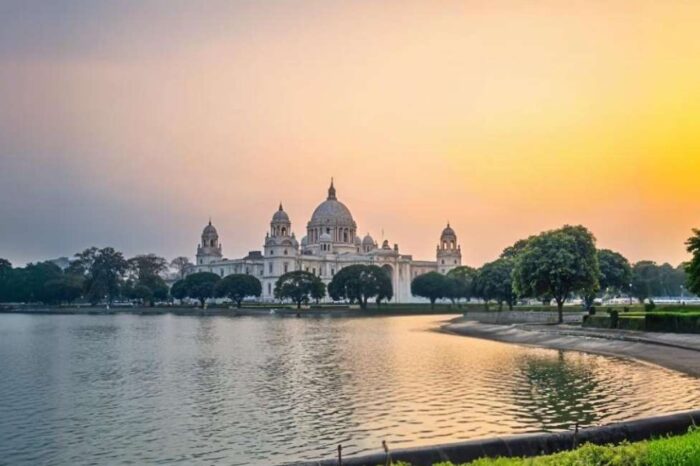
The Victoria Memorial is Kolkata’s most iconic landmark – a gleaming white marble monument set against vast green lawns, flanked by the sweeping Maidan, Asia’s largest urban park. Built between 1906 and 1921 to honour Queen Victoria, this magnificent structure is now a museum holding over 35,000 objects from the British colonial era. The Maidan that surrounds it is where Kolkata breathes – locals come here to walk, play cricket, fly kites, and simply sit by the Hooghly. The combination of majestic architecture and open green space makes this area the emotional heart of the city.
Howrah Bridge & The River Ghats
No image of Kolkata is complete without the Howrah Bridge. Completed in 1943, this cantilever truss bridge spans the Hooghly River and connects Kolkata to Howrah – bearing over 100,000 vehicles and pedestrians daily. It is not just infrastructure; it is identity. Below the bridge, the Mullick Ghat flower market erupts into colour every morning before sunrise – a riot of marigolds, roses, and tuberoses traded by hundreds of vendors. An evening cruise on the Hooghly offers views of the illuminated bridge and the ghats that will stay with you for life.
North Kolkata & Kumartuli
North Kolkata is old Kolkata – a labyrinth of narrow lanes, crumbling Raj-era mansions, age-old temples, and neighbourhood sweetshops. This is where Kolkata’s Bengali identity was forged. Within North Kolkata lies Kumartuli, the potters’ quarter – a cluster of workshops where artisans craft the spectacular clay idols of Goddess Durga that are worshipped across the world. Watching a master potter shape a goddess from river clay using hands and bamboo is one of the most humbling artistic experiences in all of India. Visit Kumartuli in the weeks before Durga Puja and witness creation in its purest form.
College Street – The Book Bazaar
College Street is Kolkata’s intellectual artery. Home to the University of Calcutta, Presidency University, and dozens of colleges, this kilometre-long street is also the largest second-hand book market in Asia – over a thousand stalls selling everything from rare first editions to affordable paperbacks. The iconic Coffee House at the corner, where generations of students, poets, revolutionaries, and filmmakers have argued over ideas since 1942, is a pilgrimage site for any lover of ideas. Come here to browse, debate, and feel the city’s undying love affair with the written word.
Park Street – The City’s Social Heart
Park Street is where Kolkata loosens its collar. Lined with restaurants, jazz bars, patisseries, and boutiques, this is the city’s social and culinary spine. From the legendary Mocambo and Flury’s (a Kolkata institution since 1927) to modern craft beer bars, Park Street has always been the address where all of Kolkata converges for celebration. During Christmas, the street transforms into a fairy-tale of lights and carols – secular, joyous, and quintessentially Kolkata. If Howrah Bridge is the city’s face, Park Street is its smile.
Kalighat & South Kolkata
Kalighat is one of the most sacred and ancient parts of Kolkata. The Kalighat Kali Temple, from which the city likely takes its name, is one of the holiest Hindu temples in India. The energy here is ancient, raw, and deeply devotional. Surrounding Kalighat is a neighbourhood of old artistic traditions – Kalighat painting, a distinctive folk-art style featuring bold strokes and satirical imagery, originated here in the 19th century. South Kolkata as a whole is a quieter, more refined counterpoint to the bustle of the north – wide avenues, leafy residential streets, and a thriving café culture that speaks to the city’s evolving spirit.
New Town & Salt Lake
Kolkata’s tomorrow lives in New Town and Salt Lake – planned townships that rise east of the old city. Eco Park in New Town is a massive recreational destination spread over 480 acres, with replicas of the Seven Wonders of the World, boating lakes, and cycling tracks. The area is home to a booming IT sector and a youthful population that has given Kolkata a second wind economically. The Biswa Bangla Convention Centre here is one of the finest in the country. New Town shows that Kolkata is not just proud of its past – it is building a future worthy of it.
Sundarbans – The Wild Edge
A few hours from Kolkata by road and ferry lies one of the most extraordinary natural landscapes on Earth. The Sundarbans is the world’s largest tidal mangrove forest – a UNESCO World Heritage Site and the only habitat in the world where the Royal Bengal Tiger lives in a saltwater ecosystem. Tigers here swim between rivers, hunt deer in the dense mangroves, and are rarely seen – making every sighting a once-in-a-lifetime event. The Sundarbans is also home to saltwater crocodiles, Irrawaddy dolphins, and a dazzling variety of migratory birds. Overnight boat safaris through the delta’s tidal channels are a surreal experience – the silence broken only by the lap of water and the distant call of kingfishers.
Bishnupur – Terracotta Town
Around 130 km from Kolkata lies Bishnupur, a small town that punches far above its size in cultural wealth. Once the capital of the Malla kings, Bishnupur is famous for its extraordinary terracotta temples – intricate structures built entirely from locally fired red brick and decorated with panels depicting scenes from the Ramayana and Mahabharata. The Rasmancha temple, built in 1600, is the oldest brick temple in Bengal. Bishnupur is also the birthplace of Bishnupuri silk and the classical Bishnupuri style of Hindustani music. A day trip here from Kolkata is one of the most culturally rewarding journeys you can make in West Bengal.
Experiences
- The 10 Best Japan Festivals for Indian Travellers
 August 24, 2026
 - The Ultimate Japan Travel Guide: 17 Must-Visit Destinations
 August 17, 2026
 - Wine Tourism in India
 June 8, 2026
 - Anini Tour
 June 5, 2026
 - Tamia Hills Tour
 June 4, 2026
Call
98742 84569
98743 61951
Mon-Sat 11.00AM-07.30PMNewsletter
Uncategorized
- Tours in BlogApril 6, 2026
- Tours in Blog
- Required plugin "Meks Easy Photo Feed Widget" is required. Please install the plugin here. or read more detailed instruction about How to setup the plugin here
Connect to Us
Recent Tours
Rate & Review Us
Contact Info
- +91 98742 84569
- experience@ocean6.in
- 16, Suren Tagore Rd, Ekdalia, Ballygunge, Kolkata, West Bengal 700019
- Mon - Sat : 11.00 AM - 7.30 PM
Sunday : CLOSED
Newsletter
Quick Links
