
The Invisible Trail: Why India’s Ancient Attar Scent-Circuit is the Next Big Travel Trend
Forget the usual itineraries. I’ve just returned from a journey that bypassed the monuments and the beaches for something far more subtle, more ancient, and deeply personal: India’s Perfume Tourism circuit. This isn’t just shopping for scents; it’s a 5,000-year-old sensory pilgrimage, an “experiencescape” where every drop of oil is a condensed piece of history.
If you are a discerning traveler (or “olfactory tourist,” as the industry calls us!), seeking authentic, artisan, and sustainable experiences, then the world of Indian Attar—the concentrated, alcohol-free, natural perfume oil—is calling your name.
The Olfactory Map: India’s Fragrance Powerhouses
The attar industry is undergoing a global renaissance, and its beating heart is found in four distinct regions, each with a unique botanical profile and an unforgettable story.
-
Kannauj: The Undisputed Perfume Capital
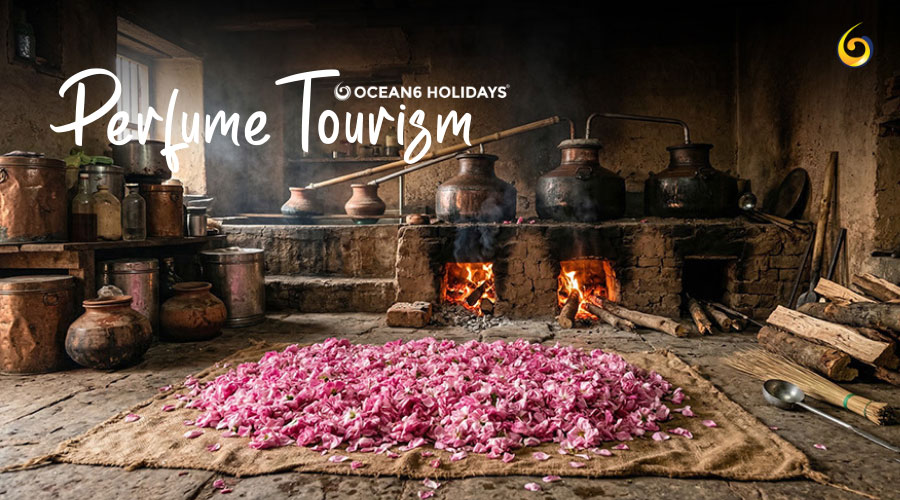
Situated in Uttar Pradesh, Kannauj is the undisputed global capital of traditional attar. For over 400 years, they have preserved the Deg-Bhapka hydro-distillation method. This labor-intensive, eco-friendly technique uses copper stills (degs) and is regulated by a master distiller (dighoo) who relies purely on sensory expertise.
- Must-Experience Scent: Mitti Attar. This is the most enigmatic of all, capturing the petrichor—the earthy scent of the first rain on dry soil—by distilling baked Ganges clay. It’s a sensory masterpiece!
- Historical Note: This was the city of perfumery under Emperor Harshavardhana in the 7th century, and the Mughals later refined the distillation method here.
-
Mysore: The Sandalwood Legacy
Synonymous with high-quality sandalwood (Santalum album), Mysore in Karnataka is where the iconic Mysore Sandal Soap was born in 1918. Visitors can tour the Government Sandalwood Oil Factory, established in 1916, to witness the laborious process of extracting the precious oil that serves as the base for almost all Indian attars.
-
Madurai: The Jasmine Economy
The cultural capital of Tamil Nadu is the primary hub for Madurai Malligai (Sambac Jasmine). The sheer volume of this flower makes the city’s Mattuthavani market a central site for olfactory tourism, where tons of buds are auctioned and transported globally every dawn. The Madurai Jasmine has deep cultural significance, used daily to adorn the deity Meenakshi Amman.
-
Pushkar: The Rose Garden of Rajasthan
This spiritual town is famous for the scent-heavy desi gulab (local rose). If you visit during the peak flowering seasons (March–May and September–December), you can explore the local rose farms and small-scale distilleries that produce the globally exported essence, along with local favorites like Gulkand (rose petal preserve) and rose water.
The ‘Experiencescape’: Interactive Tourism
Perfume tourism has moved beyond window-shopping. The new model, or “experiencescape,” is all about active engagement and hands-on artistry.
| Activity | Description |
|---|---|
| Morning Field Visits | Walk through Damask rose or Bela jasmine fields at dawn to witness the delicate, hand-harvesting process when the oil concentration is at its peak. |
| Deg-Bhapka Distillery Walks | Guided tours that offer live demonstrations of the hydro-distillation process, watching artisans work with the large copper stills. |
| Blending Workshops | Step into a ‘Fragrance Bar’ to experiment with hundreds of natural ingredients, learning to layer top, middle, and base notes to create your own bespoke attar. |
| Scent-Paired Gastronomy | High-end tours now integrate food, offering 7-course farm-to-table menus where local cuisine is expertly paired with specific aromatic notes. |
Planning Your Scent Trail: Logistics & Stays
- Best Time to Visit: The cooler months between October and March are the peak tourist season. However, check the Botanical Harvesting Calendar:
- Damask Rose: March–May & Sept–Dec
- Sambac Jasmine: April, May, June
- Saffron (Kesar): October–November
- Heritage Stays: Enhance your trip by staying in accommodations that reflect the heritage. Look for places like the Anand Bhawan Palace (Tirwa) near Kannauj, or the MY Heritage Resort in Kannauj with its own Perfume Gallery.
- Urban Scent Pockets:
- Delhi: Explore Dariba Kalan in Chandni Chowk, home to perfumeries dating back to 1816.
- Lucknow: Visit Sugandh Co. in the Aminabad district, famous for Hina Attar.
The Final Drop
The Indian perfume industry is navigating a niche renaissance, shifting from traditional retail to luxury artistry and experience-driven tourism. By exploring the aromatic heritage of India, you’re not just finding a new fragrance; you’re connecting with the ancient science of Gandhashastra and contributing to the sustainable future of thousands of artisan families.
Go and find your scent. It will be an eternal memory.